15 August 2009

Skate, Skate, Skate

In  May of 1984 I was wrapping up my senior year of high school having the time of my life working in radio. Spinning the gospel music in the afternoon following school gave me an easy way to earn money part time while studying for finals during records and preaching shows. We played Lp’s and 45’s directly to air not from carts like the bigger stations did so I actually spun vinyl as the disco DJ’s did and still do.
This experience with tight cues on our Technics SP-15 turntables was a joy. Immediate starts from a dead stop were possible with those units. When I wanted even closer starts or begin within a selection I would revert to a method called a slip cue. You would allow the platter to run underneath the record while holding the vinyl manually then releasing the record when needed. Pow! you were rockin’. High torque and perfect precision from the direct drive motors provided years of trouble free service. All but one of my non Internet radio homes used this particular model. In ‘84 a couple of them would set you back the price of a good used car, worth every penny.
Anyway, my station was hosting a Christian Skating party on Monday nights and was using our morning man Dennis Allen and others as guest DJ’s. I had no concept of their compensation but I was soon to find out some very good news. Our sponsor, Savannah Skate Inn, not actually a hotel, rather a roller rink wanted an additional skate party on Saturday nights aimed at a slightly younger clientele. The rink’s manager, Tommy, apparently wanted yours truly to host. He worked out my compensation. I was to be paid three times my hourly rate at the radio station. Wow!

Five days following my high school graduation Contemporary Christian Music rocked the Skate Inn. Church youth leaders brought in bus loads for our premiere. Admission was only $3.00, a dollar less with a coupon and free skates rental. A quarter of each admission was put into jackpot that was awarded to the largest group represented. What a win win scenario!

I was a bit nervous at first facing a live audience but soon overcame the butterflies when I realized the interactions directly with patrons presenting song requests and their putting together a face with a voice. One mother had assumed my age was 35. “Thanks ma’am, I’m only 18,” was my grateful reply. I was perched in the booth among my peers spinning my own Christian Rock ‘n Roll records, playing the Hokey Pokey, couples skates, etc.

One faux pas has haunted me to this day. During one contest, all girl skate, I proclaimed to a skater taking her for a boy, “That’s all girls!”. “I am a girl,” was her curt reply. Egg all over my face, I proceeded with the segment gesturing an apology to the young lady.
Savannah Skate Inn had a nice equipment setup. Two direct drive turntables; good consumer models not suitable for a broadcast environment, a compact disco mixer, a cool Teac C-2 rack mount cassette deck (the $1,000 consumer version of the professional Tascam 122B), cheap microphone, massive amplification and huge pro theater style loudspeaker cabinets. Music to hear and feel.
Two months passed with various success and little controversy until one day at my main radio job I received a phone call from the manager of cross town rival Skatetime USA requesting I move the Christian Youth Skate and my record collection to his facility. I had seen crowds dwindling at the Skate Inn and saw the handwriting on the wall. Manager Tommy had already cut 30 minutes from the 3 and a half hour party so I was ready for the new gig. I preceded thinking I would get sales commission for the new Skatetime USA account but was shocked to find out that although I did all the leg work with contracts and producing commercials it became a “house account” because the client had initially called the station so no commission was issued. Bull malarkey. I missed out on the commission but it was now too late to un-burn a bridge with Tommy who understandably felt betrayed by me and my commercial spots and the new Youth Skate now a direct competitor on Mondays at Skatetime. The next assignment was a newer facility who the manager touted as sounding better, louder and gave more liberty in music selection.

Two distinct details I remember clearly from Skatetime USA; aside from their better turntables, Technics SL-1200's, was once the manager had me play “Good ‘Ole Boys” from the then current Dukes of Hazzard TV series. One could feel this mostly Christian crowd groan in disapproval. There had been a famous song I often played by the Southern Gospel group Dixie Melody Boys which was a reply to the popular Waylon Jennings ditty, the Gospel gospel version answered;
“Good ole boys won’t make it into heaven; Good ole boys won’t wear a crown; Good ole boys won’t live forever where the saints of God are found…”
Next, a live local band joined the party one Monday night. Suddenly I became emcee and apparent fan of the unknown act shouting like a boxing ring announcer, “Ladies and gentlemen…Second Wind!” The band then exploded with a few original numbers. It was a pleasant surprise that evening for sure.

By the third Monday in August of ‘84 the party was discontinued by the manager who had been so instrumental in pulling me away from the Savannah Skate Inn just a month prior. He paid me in advance and told me the bad news. I actually took it in stride probably because I had brought a date along and didn’t want her to see me in an unpleasant light. It seems likely that we left the party early that night because it was not yet dark outside. Afterwards I made one or two likely unpaid appearances at Tommy’s place. I don’t recall patching things up with him. Time has erased the details.

Three years later in 1987 I found myself at Paulding County Skate Center playing upbeat Christian records for listeners of WSPZ, my second radio home. This experience was quite vanilla compared to my previous. I don’t remember any money being offered and possibly shared hosting duties with the stations other personalities. My production values had blossomed so the commercials are the part best remembered. I began them with line, “Skate, Skate, Skate..” My voice was split via multiple tape tracks, filtered and made lower. I then borrowed my top 40 DJ voice for the copy with a funky bass beat playing underneath. For many years to follow my work buddy Corky Cheek, whom I’d also work with at WBKI, would greet me by intoning Skate…Skate…Skate.
Click play to hear the Skate commercials

Stay tuned

14 August 2009

Skate, Skate, Skate

In  May of 1984 I was wrapping up my senior year of high school having the time of my life working in radio. Spinning the gospel music in the afternoon following school gave me an easy way to earn money part time while studying for finals during songs and preaching shows. We played Lp’s and 45’s directly to air not from carts like the bigger stations did so I actually spun vinyl as the disco DJ’s did and still do.
This experience with tight cues on our Technics SP-15 turntables was a joy. Immediate starts from a dead stop were possible with those units. When I wanted even closer starts or begin within a selection I would revert to a method called a slip cue. You would allow the platter to run underneath the record while holding the vinyl manually then releasing the record when needed. Pow! you were rockin’. High torque and perfect precision from the direct drive motors provided years of trouble free service. All but one of my non Internet radio homes used this particular model. In ‘84 a couple of them would set you back the price of a good used car, worth every penny.
Anyway, my station was hosting a Christian Skating party on Monday nights and was using our morning man Dennis Allen and others as guest DJ’s. I had no concept of their compensation but I was soon to find out some very good news. Our sponsor, Savannah Skate Inn, not actually a hotel, rather a roller rink wanted an additional skate party on Saturday nights aimed at a slightly younger clientele. The rink’s manager, Tommy Edwards, apparently wanted yours truly to host. He worked out my compensation. I was to be paid three times my hourly rate at the radio station. Wow!

Six days following my high school graduation Contemporary Christian Music rocked the Skate Inn. Church youth leaders brought in bus loads for our premiere. Admission was only $3.00, a dollar less with a coupon and free skates rental. A quarter of each admission was put into jackpot that was awarded to the largest group represented. What a win win scenario!

I was a bit nervous at first facing a live audience but soon overcame the butterflies when I realized the interactions directly with patrons presenting song requests and their putting together a face with a voice. One mother had assumed my age was 35. “Thanks ma’am, I’m only 18,” was my grateful reply. I was perched in the booth among my peers spinning my own Christian Rock ‘n Roll records, playing the Hokey Pokey, couples skates, etc.

One faux pas has haunted me to this day. During one contest, all girl skate, I proclaimed to a skater taking her for a boy, “That’s all girls!”. “I am a girl,” was her curt reply. Egg all over my face, I proceeded with the segment gesturing an apology to the young lady.
Savannah Skate Inn had a nice equipment setup: Two direct drive turntables; not the reference standard Technics SL-1200 found in discos and rinks worldwide; although not suitable for a broadcast environment, a compact disco mixer, a cool Teac C-2 rack mount cassette deck (the $1,000 consumer version of the professional Tascam 122B), cheap microphone, massive amplification and huge pro theater style loudspeaker cabinets. Music to hear and feel.
Two months passed with various success and little controversy until one day at my main radio job I received a phone call from the manager of cross town rival Skatetime USA requesting I move the Christian Youth Skate and my record collection to his facility. I had seen crowds dwindling at the Skate Inn and saw the handwriting on the wall. Manager Tommy had already cut 30 minutes from the 3 1/2 hour party and would have continued sans salary so I was ready for the new gig. I preceded thinking I would get sales commission for the new Skatetime USA account but was shocked to find out that although I did all the leg work with contracts and producing commercials it became a “house account” because the client had initially called the station so no commission was issued. Bull malarkey. I missed out on the commission but it was now too late to un-burn a bridge with Tommy who understandably felt betrayed by me and my commercial spots for the new Youth Skate now directly competing on Mondays. The next assignment was a newer facility who the manager touted as sounding better, louder and gave more liberty in music selection. In my youthful exuberance I cannibalized a loyal account to make a buck. What a backfire!


The sound booth at Skatetime USA was a little bit different from Skate Inn. They had the superior Technics SL-1200 turntables, industry standard to this day for club DJ's who still use vinyl. Instant starts just like the more costly SP-15's. I was reacquainted with these decks at radio home number four, WBKI, the only time I've seen these semi-pro machines used in a broadcast environment. Generally, rink equipment is primitive and clunky compared to fully professional gear. I often fantasized a rink with superior broadcast equipment.  A live remote from the party would have been a super idea allowing dual payment. Although the station would have weaseled out of paying me somehow just as they had with the deserved commission. 


Two distinct details I remember clearly from Skatetime USA was once the manager had me play “Good ‘Ole Boys” from the then current Dukes of Hazzard TV series. One could feel this mostly Christian crowd groan in disapproval. There had been a famous song I often played by the Southern Gospel group Dixie Melody Boys which was a reply to the popular Waylon Jennings ditty, the Gospel gospel version answered;
“Good ole boys won’t make it into heaven; Good ole boys won’t wear a crown; Good ole boys won’t live forever where the saints of God are found…”
Next, a live local band joined the party one Monday night. Suddenly I became emcee and apparent fan of the unknown act shouting like a boxing ring announcer, “Ladies and gentlemen…Second Wind!” The band then exploded with a few original numbers. It was a pleasant surprise that evening for sure.

By the third Monday in August of ‘84 the party was discontinued by the manager who had been so instrumental in pulling me away from the Savannah Skate Inn just a month prior. He paid me in advance and told me the bad news. I actually took it in stride probably because I had brought a new friend along and didn’t want her to see me in an unpleasant light. It seems likely that we left the party early that night because it was not yet dark outside. Afterwards, on into early '85, I made one or two unpaid appearances at Tommy’s place. I don’t recall patching things up with him or if it had ever been an issue between us. He had only communicated through my station manager. Time has erased the details. Ironically, Tommy never restricted my creative freedom or had other entertainment take the spotlight.

Three years later in 1987 I found myself at Paulding County Skate Center playing upbeat Christian records for listeners of WSPZ, my second radio home. This experience was quite vanilla compared to my previous. I don’t remember any money being offered and possibly shared hosting duties with the stations other personalities. My production values had blossomed so the commercials are the part best remembered. I began them with line, “Skate, Skate, Skate..” My voice was split via multiple tape tracks, filtered and made lower. I then borrowed my top 40 DJ voice for the copy with a funky bass beat playing underneath. For many years to follow my work buddy Corky Cheek, whom I’d also work with at WDCY and WBKI, would greet me by intoning Skate…Skate…Skate. Press play to sample the original commercials.


Stay tuned

13 August 2009

We’re Douglas Country!

Radio home number three has been very hard to write about because it ended in a bitter divorce. Just like the child, little J-O-E, in the famous Tammy Wynette song I needed shelter from the awful truth. I realize now, 18 years later, having survived a bad first marriage in real life a decade ago this radio separation thing was a walk in the park. Both marriages lasted only 10 months.

Third time around was another unique situation. This new owner held a General Radiotelephone Operator License (GROL). I was impressed with his credentials and his engineering background in both radio and TV. The honeymoon soon ended when I discovered his hardnosed, dictatorial approach to managing our staff. This radio home was now owned by one individual owner operator not a corporation or church organization like my previous employers. Imagine Fidel Castro rolled up into Adolf Hitler. So as not to defame the dead, I’ll call him Bill.

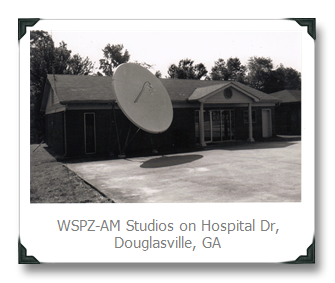
The church that had owned WSPZ had become desperate to unload this albatross hung around their neck. So desperate, in fact, that  Bill wound up paying less than a tenth of the original asking price of the station less the studio building, which he’d lease from April until we moved the following summer of 1990.

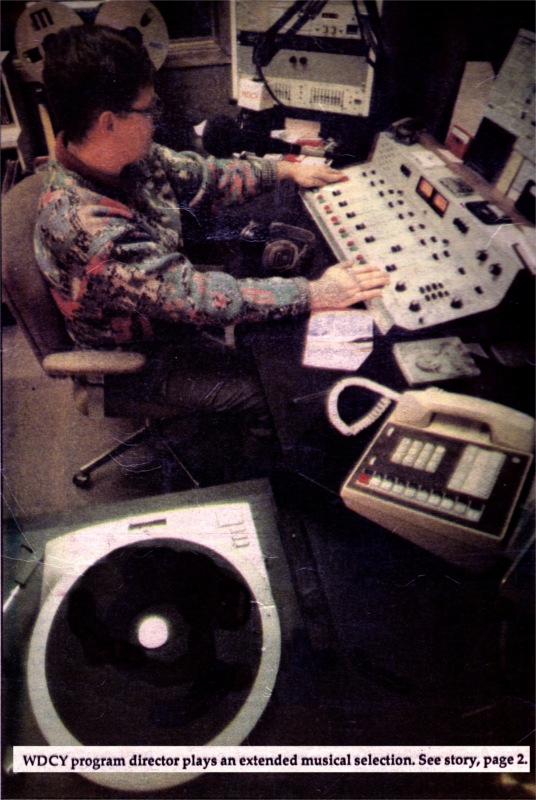
Bill, 58 years old, entered with flattery, focusing his attentions on my office of program director. He seemed to value my role and appointed me architect of the new image. What an ego expedition this turned out to be for me. I came up with the new call letters WDCY-AM, representing We’re Douglas County. We realized the focus of the former owners was too broad. They had assumed our 2,500 watt signal would penetrate the Atlanta environs and marketed us as such. We decided to do a heavy local push by adding a news director and field reporters, making our presence known in the business community, covering nearby high school sports events and doing live remotes ad nauseam. Bill had some great ideas; made some tough adjustments to staff and bruised many egos along the way, but I must say that it was never boring. Bill and I were just too different. He never had a proper understanding of our Southern Gospel music format often referring to it as Barber Shop Quartet. I was an impetuous 24 year old bent on winning control over the old man’s station. Boy, was I wrong!

I believe a pivotal moment for Bill was a Gospel concert he had masterminded, not meeting his expectations, although I saw it as a success during the culmination of Southern Gospel Music Month in September of ‘90. I pled the cause of Gospel music, but he seemed soured by the experience and preferred to go to what he called Country and Western. Who called Country that anymore? Secretly, I knew a secular format would not work for me and would probably quit should we change. Anyway, for the first time ever I was forced to take an on-air partner and produce a morning show modeled after the morning zoo fluff shows popular those days. The Mabry & O’Neal Morning Show was born around November with promotions director slash occasional news reporter, Angie Mabry. We both worked hard at it but the show was incompatible with our audience. We seldom ever referred to the Gospel music or religion at all.

article c By February of 1991 Bill had trimmed the now bloated air staff taking on some air time himself. This change put me on-air 6 days a week thereby stealing vital time away from the office and production room tasks necessary for perfecting our sound. The balancing act proved humanly impossible and I resigned during the transition to the inevitable and ultimately ill fated format change to country and a new slogan, We’re Douglas Country.

Stay tuned

We’re Douglas Country!

Radio home number three has been very hard to write about because it ended in a bitter divorce. Just like the child, little J-O-E, in the famous Tammy Wynette song I needed shelter from the awful truth. I realize now, 18 years later, having survived a bad first marriage in real life a decade ago this radio separation thing was a walk in the park. Both marriages lasted only 10 months.

Third time around was another unique situation. This new owner held a General Radiotelephone Operator License (GROL). I was impressed with his credentials and his engineering background in both radio and TV. The honeymoon soon ended when I discovered his hardnosed, dictatorial approach to managing our staff. This radio home was now owned by one individual owner operator not a corporation or church organization like my previous employers. Imagine Fidel Castro rolled up into Adolf Hitler. So as not to defame the dead, I’ll call him Bill.

The church that had owned WSPZ had become desperate to unload this albatross hung around their neck. So desperate, in fact, that Bill wound up paying less than a tenth of the original asking price of the station less the studio building, which he’d lease from April until we moved the following summer of 1990.

Bill, 58 years old, entered with flattery, focusing his attentions on my office of program director. He seemed to value my role and appointed me architect of the new image. What an ego expedition this turned out to be for me. I came up with the new call letters WDCY-AM, representing We’re Douglas County. We realized the focus of the former owners was too broad. They had assumed our 2,500 watt signal would penetrate the Atlanta environs and marketed us as such. We decided to do a heavy local push by adding a news director and field reporters, making our presence known in the business community, covering nearby high school sports events and doing live remotes ad nauseam. Bill had some great ideas; made some tough adjustments to staff and bruised many egos along the way, but I must say that it was never boring. Bill and I were just too different. He never had a proper understanding of our Southern Gospel music format often referring to it as Barber Shop Quartet. I was an impetuous 24 year old bent on winning control over the old man’s station. Boy, was I wrong!

I believe a pivotal moment for Bill was a Gospel concert he had masterminded, not meeting his expectations, although I saw it as a success during the culmination of Southern Gospel Music Month in September of ‘90. I pled the cause of Gospel music, but he seemed soured by the experience and preferred to go to what he called Country and Western. Who called Country that anymore? Secretly, I knew a secular format would not work for me and would probably quit should we change. Anyway, for the first time ever I was forced to take an on-air partner and produce a morning show modeled after the morning zoo fluff shows popular those days. The Mabry & O’Neal Morning Show was born around November with promotions director slash occasional news reporter, Angie Mabry. We both worked hard at it but the show was incompatible with our audience. We seldom ever referred to the Gospel music or religion at all.

article c By February of 1991 Bill had trimmed the now bloated air staff taking on some air time himself. This change put me on-air 6 days a week thereby stealing vital time away from the office and production room tasks necessary for perfecting our sound. The balancing act proved humanly impossible and I resigned during the inevitable and ultimately ill fated format change to country and a new slogan, We’re Douglas Country.

Stay tuned

12 August 2009

My First Radio Station


Gosh. My first station; what an odd, yet wonderfully unique format. It was a Gospel station with at least three dayparted formats. That meant we played a different style of music or programming depending on the time of day you were listening. Southern Gospel in the morning then time brokered religious programs mid-day, followed by traditional and urban contemporary Black Gospel. I loved it all. By 1986 I began my afternoon drive show with 30 minutes of Southern Gospel; the the rest of my broadcast was Contemporary Christian till 9pm. The listeners were confused, but what an education I gleaned from Gospel 90 WEAS AM (later WWJD) in Savannah, Georgia. I got from it a deeper appreciation for all forms of music as well as a priceless lexicon of Gospel trivia. 

The station was originally licensed to Savannah on 900kc in 1950 despite legal objections from the local broadcast community. See http://www.lawskills.com/case/ga/id/18820/Then it was known as WJIV. They played what was termed at the time "race records". Modeled after the highly successful WDIA in Memphis, Tennessee, WJIV served the African American community exclusively for about a dozen years. Forward to about 1963; WJIV station owner, E.D. "Dee" Rivers, Jr, moved the call letters "WEAS" from his Atlanta station on 1010 AM, today known as WGUN, to the Savannah station. In my research I discovered that Rivers also made an unsuccessful bid for a TV station called WJIV-TV. Coinciding with the call sign change was a shift to a "Hillbilly" format, what we know now as Country. What a contrast! But it seems these listeners were under served and Rivers once again filled a demographic need. I imagine the sounds of Patsy Cline and Hank Williams were interspersed with preachers and the occasional Gospel tune. A few years later in '68 the 100,000 watt WEAS-FM was born. It began as an automated "Beautiful Music" or "Easy Listening" format. The FM later programmed  "Progressive Rock" till the mid 70's. That's when I believe the "E-93" brand became reality. They were now serving the black community full time, the format that's a ratings winner for them until this day. I understand that the AM and FM were simulcasting in the morning in those days. The AM split away from the FM mid-day with preachers and Southern Gospel music 'til sun down.


By the time I joined WEAS-AM in May of 1983 it was mostly Southern Gospel. During the next 3 years the format evolved into the hybrid I described. Each disk jockey picked his own music. I could usually tune in at home and know which DJ was on by the music he or she played! It sounds as though it would be chaotic, but it worked, mostly.

Late 1983 enter a new manager from Arkansas one Charles Lewallen. He was a minister and believed in strict format. He objected to diluting our music selections with other variations of the Gospel form. One time he told me not to play a certain New Gaither Vocal Band selection because it sounded too "rock". That seems so ridiculous now. Gaither? Rock? I was 17 in October of 1983 when Charles changed our call letters to WWJD. The new call sign didn't easily roll off my tongue and was ten plus years before the unrelated WWJD bracelets. The acronym did NOT represent "What Would Jesus Do". Our name stood for, "Walking With Jesus Daily". A possible motive for the switch was a disassociation with our sister, WEAS-FM. Being a green teenager I complied with whatever management said. I had very little to do with the business end of radio until much later in my career.

The Atlanta Journal-Constitution reported in their January 30, 1985 issue that Mr. Lewallen had wrongfully fired a female black announcer, Lucy Frazier, in summer '83. The report said she was suing the station for damages in US District court in Atlanta. I don't know how the case was settled but it explains a lot! Charles abruptly disappeared early 1984 or slightly before. The paper quoted him as saying, it was, "inappropriate for a black woman to play white gospel records ."

At the time we had a staff meeting admonishing us to remain quiet on the situation.  Obviously, this manager had an eye on brand issues and image of the station, hopefully not skin color or gender. I'm not qualified to psychoanalyze his motive as racial. His side is not very well represented in the article. I think this incident prompted the addition of black Gospel music to our line up. Borrowed from our FM, Lester "Leck" White was eventually added mid-days to provide some soul.

During this whole time the glue that held our little 5,ooo watt station together was my dear friend and mentor Gloria. She had interviewed and hired me in the spring of 1983 and served as manager for my entire 3 1/2 year tenure. She had been pushed to the side briefly when Lewallen took over. I overheard a conversation between she and another DJ. She had felt slighted by the apparent demotion and threatened to quit. Long story short, she outlasted the new "manager" many years.

I would describe Gloria's management style as easy going, much like her on-air persona. Our DJ's pretty much had free reign. Not that we were allowed to play Led Zeppelin records or anything, I just mean we played almost any Gospel we wanted. We all felt trusted. She had a few exceptions though.  A lot of upbeat Contemporary Christian numbers were forbidden, such as the Imperials' "Water Grave", from the "Sail On" album. A great many of the "Do not play" list were deliberately scratched through on the record album and rendered unplayable; a primitive, but effective insurance of compliance.

This changed in September of 1986. We were going to switch to Contemporary Christian! As a 20 year old Christian youth who loved mainstream top 40 this was super news. The station had now been granted approval for 24 hour operation. For the 36 years prior to this occasion we were a "Daytimer", signing on at sunrise and signing off at sunset. As a concession to more powerful clear channel AM stations, our transmitter power was greatly reduced at night. We probably deferred to the powerhouse 890 AM WLS Chicago. I was made music director and coined  J-900 as a brand for our new sound.

The novelty wore off. I  found out that the "format" would only apply to certain dayparts. CCM would be heard only after 3:30 pm. I saw this as a weak commitment to the music. The local conservative preaching shows must have dictated our sound. Bummer! Our aim was to reach the youth demographic with the hotter sound. It was reasoned that most kids listened after class. A few outspoken callers to the station during that time of day were Christian private school students who reported that parents did not allow them to listen to any secular music. In them we had a small captive audience to supplement our regulars probably confused by our diverse sound. (Click on the Mp3 below for a sample.)

We ventured past midnight to the likes of Michael W. Smith's "Rocket Town" and maintained the show until I left the station for the Atlanta market in late November of '86. I had declined an opportunity to work for the 50,000 watt sister station WGUN in Atlanta, interviewed at Love 86 WAEC-AM, and by February of 1987 found my self at a new home, the 1Kw daytimer, WSPZ-AM in suburbia.

Stay Tuned.

Tower Collapse

Working in small and medium market radio has had its foibles. For instance,  budget restraints in the technical department. I may not know what I am talking about but I believe that all of my chief engineers were moonlighting away from their main gig. My first chief, Dennis, was employed by the number one station in the market and retained by my station part time. At my second radio home Richard was another fine engineer on call to us but yet again his allegiance was to a big Atlanta FM. I had a great rapport with these guys and tried to learn as much about their craft as I could. I knew their hands were tied by our smaller budgets so a lot of maintenance was differed. Still, it was no less frustrating when something major got screwed up.

My first radio station had numerous technical issues although I believe our owners had very deep pockets. One DJ in our FM department once commented that, “Someone could pee down the street and knock us off the air”. Crass but true, he was almost right because it only took a mild thunderstorm to kick both AM and FM off the air.  The FM’s signal was almost always monaural not the clear stereo of our competition. Lightning once fried a transmitter making us sound no better than a citizens band (CB) radio. I was advised to switch it off and go home an hour early.

Around Saint Patrick’s day of 1985 some water craft on the Savannah River severed our STL (Studio Transmitter Link) line. All the air staff were moved out to the remote transmitter site to broadcast directly. The FM had emergency equipment there but we in AM were stuck with two Marantz Superscope portable cassette recorders and one patch cord directly wired to the transmitter. In an earlier post, Beam Me Up Scottie, I described the poor audio experience. It  lasted two days but seemed much longer. Bell South dropped us a new line in short order.

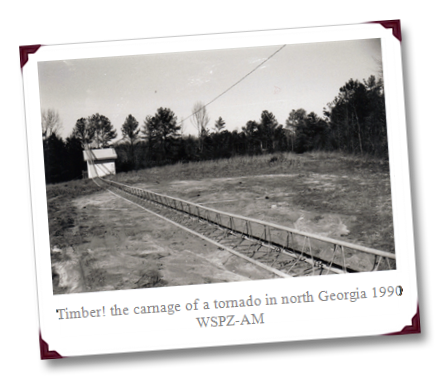
Five years later at my new radio home, WSPZ-AM, located just west of Atlanta, a tornado blew down our broadcast tower. This time I was off the air for two weeks without the luxury of a back up plan. Luckily for the staff, we reported for work and were paid. The station was awaiting FCC approval of transfer of ownership and feared the collapse would hinder the sale.

Station number two was the opposite of my first. WSPZ was owned by a smallish local church. The owners had spent an obscene amount of money on all new professional studio equipment and had for its size the best AM audio this DJ has ever herd. I feel that the owners were overextended when we first learned the station was for sale, 2 1/2 years prior to the tornado. A sizable investment was wasted on a 1Kw signal with 500 watts critical hours. The power was increased in about 1988 which meant another wad of cash for a new transmitter for only an increase to two and a half thousand watts. You may think that’s more than double the power but remember engineers tell us that to actually double your output on AM there has to be a ten fold increase in wattage. So, obviously, an allowance of 10,000 watts would have actually paid off.

what’s ironic about SPZ, the station’s listed price of $750,000 in 1987 was lowered numerous times and actually sold for a mere $70,000 a tenth in 1990. That’s what I call poor return on investment. For three years I was basically babysitting. I made a decent living doing something I loved and do not regret a thing. It is funny that my original radio home was owned by tightwads who refused a lot of the basics on stations with enormous potential while my second place was owned by free spenders beating a dead horse. I guess you can’t have it all.

Stay tuned.

Tower Collapse

Working in small and medium market radio has had its foibles. For instance,  budget restraints in the technical department. I may not know what I am talking about but I believe that all of my chief engineers were moonlighting away from their main gig. My first chief, Dennis, was employed by the number one station in the market and retained by my station part time. At my second radio home Richard was another fine engineer on call to us but yet again his allegiance was to a big Atlanta FM. I had a great rapport with these guys and tried to learn as much about their craft as I could. I knew their hands were tied by our smaller budgets so a lot of maintenance was differed. Still, it was no less frustrating when something major got screwed up.

My first radio station had numerous technical issues although I believe our owners had very deep pockets. One DJ in our FM department once commented that, “Someone could pee down the street and knock us off the air”. Crass but true, he was almost right because it only took a mild thunderstorm to kick both AM and FM off the air.  The FM’s signal was almost always monaural not the clear stereo of our competition. Lightning once fried a transmitter making us sound no better than a citizens band (CB) radio. I was advised to switch it off and go home an hour early.

Around Saint Patrick’s day of 1985 some water craft on the Savannah River severed our STL (Studio Transmitter Link) line. All the air staff were moved out to the remote transmitter site to broadcast directly. The FM had emergency equipment there but we in AM were stuck with two Marantz Superscope portable cassette recorders and one patch cord directly wired to the transmitter. In an earlier post, Beam Me Up Scottie, I described the poor audio experience. It  lasted two days but seemed much longer. Bell South dropped us a new line in short order.

Five years later at my new radio home, WSPZ-AM, located just west of Atlanta, a tornado blew down our broadcast tower. This time I was off the air for two weeks without the luxury of a back up plan. Luckily for the staff, we reported for work and were paid. The station was awaiting FCC approval of transfer of ownership and feared the collapse would hinder the sale.

Station number two was the opposite of my first. WSPZ was owned by a smallish local church. The owners had spent an obscene amount of money on all new professional studio equipment and had for its size the best AM audio this DJ has ever herd. I feel that the owners were overextended when we first learned the station was for sale, 2 1/2 years prior to the tornado. A sizable investment was wasted on a 1Kw signal with 500 watts critical hours. The power was increased in about 1988 which meant another wad of cash for a new transmitter for only an increase to two and a half thousand watts. You may think that’s more than double the power but remember engineers tell us that to actually double your output on AM there has to be a ten fold increase in wattage. So, obviously, an allowance of 10,000 watts would have actually paid off.

what’s ironic about SPZ, the station’s listed price of $750,000 in 1987 was lowered numerous times and actually sold for a mere $70,000 a tenth in 1990. That’s what I call poor return on investment. For three years I was basically babysitting. I made a decent living doing something I loved and do not regret a thing. It is funny that my original radio home was owned by tightwads who refused a lot of the basics on stations with enormous potential while my second place was owned by free spenders beating a dead horse. I guess you can’t have it all.

Stay tuned.

11 August 2009

Breakfast with Burl

  The radio station I listened to most as a kid was Z-102 in Savannah, Georgia. Now, I realize that the station was only another Z-100 New York clone. This CHR format over populated the FM dial all across the USA in the 1980’s. Yes it was derivative but I enjoyed the station and copied their style often when I became a Contemporary Christian Music DJ. One unique element of good old WZAT-FM was Burl Womack. His show “Breakfast with Burl” was on my car radio every morning on my way to high school. Burl was allowed to play Southern Gospel music along with Adult Contemporary and hits of the day. Strange combination of styles but it worked! Burl had the number one show on the number one station in the market for years.


  Womack was a mature man with an easy going style and mellifluous baritone. He’d get to a point in the show where he would pour another cup of coffee (a sound effect from a cart tape, no doubt) address the topics of the day, read the school lunch menu and, as best as I can recall, played his choice of Gospel music until at least 8:00 AM. He seemed to be actually having breakfast with you. The show was aptly named. To this day I wonder why he didn’t make the jump to television, he reminded me of David Hartman, one time host of ABC’s Good Morning America.


  I met Burl on two separate occasions once at at the Savannah Skate Inn roller rink where I hosted a Christian Youth Skate and then again a few months later when he emceed a Dixie Melody Boys concert at a private school auditorium in Garden City. What struck me most about the main was his vocal power in person. His speaking voice was laid back and boomed even though he spoke softly. I was intimidated and our exchange was minimal, after all what did I as an 18 year old upstart have to offer? It was a mystery to me why he was at the skating rink and at the time I felt he gave me the brush off although he was probably hurried or surprisingly, shy. A few months later at the Gospel concert he did a splendid job as emcee and I saw a humorous side to the man not always evident on his radio show. That night I was asked to stand as representative of my radio station during the concert. Typical of me I was embarrassed, quickly stood, waved, said nothing and sat down.


  Burl has been nominated in 2009 for a lifetime Career Achievement Award by the Georgia Radio Hall of Fame. Good luck to you Mr. Womack you deserve the honor. Your many years on the Savannah airwaves are fondly remembered by your fans and I am one.


Stay tuned.


Breakfast with Burl

The radio station I listened to most as a kid was Z-102 in Savannah, Georgia. Now, I realize that the station was only another Z-100 New York clone. This CHR format over populated the FM dial all across the USA in the 1980’s. Yes it was derivative but I enjoyed the station and copied their style often when I became a Contemporary Christian Music DJ. One unique element of good old WZAT-FM was Burl Womack. His show “Breakfast with Burl” was on my car radio every morning on my way to high school. Burl was allowed to play Southern Gospel music along with Adult Contemporary and hits of the day. Strange combination of styles but it worked! Burl had the number one show on the number one station in the market for years.

Womack was a mature man with an easy going style and mellifluous baritone. He’d get to a point in the show where he would pour another cup of coffee (a sound effect from a cart tape, no doubt) address the topics of the day, read the school lunch menu and, as best as I can recall, played his choice of Gospel music until at least 8:00 AM. He seemed to be actually having breakfast with you. The show was aptly named. To this day I wonder why he didn’t make the jump to television, he reminded me of David Hartman, one time host of ABC’s Good Morning America.

I met Burl on two separate occasions once at at the Savannah Skate Inn roller rink where I  hosted a Christian Youth Skate and then again a few months later when he emceed a Dixie Melody Boys concert at a private school auditorium in Garden City. What struck me most about the main was his vocal power in person. His speaking voice was laid back and boomed even though he spoke softly. I was intimidated and our exchange was minimal, after all what did I as an 18 year old upstart  have to offer? It was a mystery to me why he was at the skating rink and at the time I felt he gave me the brush off although he was probably hurried or surprisingly, shy. A few months later at the Gospel concert he did a splendid job as emcee and I saw a humorous side to the man not always evident on his radio show. That night I was asked to stand as representative of my radio station during the concert. Typical of me I was embarrassed, quickly stood, waved, said nothing and sat down.

Burl has been nominated in 2009 for a lifetime Career Achievement Award by the Georgia Radio Hall of Fame. Good luck to you Mr. Womack you deserve the honor. Your many years on the Savannah airwaves are fondly remembered by your fans and I am one.

Stay tuned.


06 August 2009

Welcome to The Shack

First of all I am not an official representative of any retail corporation and have not been compensated in any way.

One of my favorite hang outs in my youth was Radio Shack. I remember when I was ten my dad introduced me to my favorite store showing me a stack of magnets the retailer kept by the register. I was intrigued by not only how the magnets attracted each other but if you flipped one of these ceramic disks over they repelled one another by equal force. Then I discovered how many more interesting gadgets the store sold. It was paradise for a technology geek like me. I could usually leave the store having spent not much money because most of my purchases were small parts for my own projects.

Just like Federal Express became Fed Ex and Kentucky Fried Chicken KFC my favorite store is now The Shack. In this modern age I suppose the “Radio” in their name sounds archaic. Maybe it is a throwback to an earlier time, but I hope us old guys are not forgotten because I believe we hobbyists are still alive and well. I understand they’ll still be know legally as Radio Shack.

This got me thinking, should the Radio Rewind weblog become The Rewind? How about an unpronounceable symbol just as Prince renamed himself a few rears back? Nah! I’ve already renamed it one time but I do see the wisdom in dropping part of a name to sound more hip (cool, or whatever the new word is) in today’s youth driven marketing.

Great Expectations

As a youngster I took a job in AM radio. It was old fashioned even then, 26 years ago, for a 17 year old to listen to AM, although FM had just, at the close of the 1970’s, become king of the airwaves overtaking AM in popularity. Just like the CD all but destroyed the LP. The superior technology wins. Throughout my entire 12 year run in AM I felt it was a medium for the elderly. I wasn’t the target demographic of any of the stations I worked for. I listened as part of my job.

My first few unfledged turns at the microphone I could rely on school mates and family to listen while slowly building a wider legitimate audience as I learned to fly; I believe that by the time I began life at my second radio home, now a bit more seasoned, literally no one was listening excluding me. Known then as Jim O’Neal I had no captive audience on which to build. In retrospect, the hobby aspects of the new job was all I had. Don’t get me wrong, I was extremely lucky to be working in a career I loved. But when you’re on a 1,000 watt daytimer with critical hours of 500 watts your station is pretty much mathematically eliminated. I will discuss WSPZ-AM, my radio home from 1987 through 1990, in a future installment of my companion blog Peanut Whistle. See it at http://peanutwhistle.blogspot.com

Stay tuned.

05 August 2009

The Silent Decades

For over ten years I thought very infrequently of my radio past. Up until Fall of 2008 I had suppressed any thought or public mention of my previous life in broadcast media. One evening while working as manager of an auto parts retail store I was discussing with a fellow manager and part time country musician his passion for recording his music. I know he wasn’t impressed by my story but I felt the need to enlighten him with the brief details of my 12 year DJ career. I was ignored but relieved that I finally revealed a past that I was quite proud of at one point and I really didn’t expect his arrogant personality to receive it. The conversation was merely a catalyst for a new phase of my life.

It was a load off my chest because I was once again captured by the radio bug. I was burned out with the retail hell into which I had fallen. I needed more out of life. I was waxing sentimental over my old career and could not escape thinking about and writing about it. This obsession eventually became a blog, podcast and Internet radio station, The GRIN.

Still, I need a tangible outlet for my audio passion. As I noted in my last post I’m trying to get involved in church sound and media again. This objective seems out of reach. I detect little movement from those who could use me and I am somewhat discouraged. Do I face reality and completely abandon my dream? Or should I be more proactive?

Is it 1995 all over again when I saw a new door open in a completely different field? ‘95 was a turning point into the world of retail. It was my final foray into radio because my new employer would not allow me the one day a week I worked at WBTR-FM. Forward to 1999, I got involved with the sound crew of an Assembly of God church known regionally for its Revelation to Calvary production that ran for weeks and was advertised on the Atlanta market’s large FM Christian station, WVFJ.

Here I was a somewhat jaded former broadcaster now volunteering with a highly professional crew. The pastor stressed excellence in the audio and it showed. Theatrical sound effects, creative audio processing and other elements of a proper audio presentation were the norm. It was the best sound I had ever heard in a church setting. Regrettably, I had to leave the team after 8 months or so when marriage to my first wife ended in 2000. My ex attended the church before me and it was agreed that I would leave.

Another ten year cycle passes and I find myself in the present wanting to take what I’ve learned to a new church setting. The new pastor is interested in an effective media presentation complete with theater style lighting and effects. So far I’m still deciding weather to get involved with the Media Shout computer operator position Pastor sees me filling. I have liked photography, computers and video as a hobby but audio is my obsession. Maybe the path is clearer as I wrap up. I’ll see Sunday.

Stay tuned.

03 August 2009

Beam Me Up Scottie

Ever been embarrassed by the company you work for? In the early part of 1985 I was flirting with a new career Building airplanes for Gulfstream Aerospace in Savannah, Georgia. In fact I was allowed by my radio job with the Rivers’ 900 AM Gospel outfit at least five weeks away from my regular afternoon DJ gig to train for a new job  on the assembly line riveting school. While I was not in class I took on the mid-morning shift. For about 2 1/2 hours a day I babysat the station seeing that it was prime time for our bread an butter brokered preaching shows.

One weekend during this time our underwater studio to transmitter link was severed by, I was told, a submarine.  All of a sudden dead air from both our AM and FM studios.  Management decided to move air staff out to our transmitter on Hutchinson Island.

The 100,000 watt WEAS-FM  had  actual functioning studio equipment suitable for broadcasting out at the site. We at the AM on the other hand had nothing. I am not exaggerating, we literally had two Marantz Superscope portable cassette players with one patch cord attached directly to our audio processor. I would play one cassette on air and use the alternate player to cue the next tape. When one tape ended I had to manually switch the patch cord from one Superscope to the other. Not even a simple mixer or microphone was available. I was assigned to enter the production room facilities at our regular location following my evening training in Pooler to make mix tapes and dubs of reel-to-reel to play during the crisis. I guess these tapes were used for music and preaching when I was not on air. Thank God we were only a daytimer. This setup was all we had. The tapes sounded like crap. Cheap. Cheap.

This time of my life was pivotal for me. I was now ashamed of our highly unprofessional emergency station that sounded as if a 5 year old was using his Fisher Price tape player to broadcast Gospel preaching shows.  Fortunately, a new line was dropped by the phone company and we were back to normal in less than a week. My passion for this low paying job began to wane. The station did not represent the brand quality I heard elsewhere in the market. I was not proud as I once was of the 5,000 watt station that employed me. My perception was forever changed.

I didn’t accept the job out at Gulfstream and returned full time to radio. As the months passed I slowly slipped into the old routine while extremely dissatisfied making the best of the situation. In those days all I ever looked forward to was change. Our hands were tied by sloppy ownership who seemed to neglect the AM at every turn. Keeping sales people was impossible. Had it not been for the preachers and our FM sister we’d have probably gone dark. The Gospel music or the PSA’s we played couldn’t have supported us.  Bad decisions such as call letter change in October of ‘83 were contributing factors to the station’s eventual demise in 1987. Prior to the identity swap we had professional ID’s and jingle packages. As a youngster I felt these elements made a radio station sound pro even if the talent didn’t. No Investment was ever made in the new WWJD branding. An outsider from Arkansas  hired as “Manager”  invented the new call letters but stopped short by not injecting a new image listeners could relate to or advertising the station in other media. I was too young and inexperienced at the time so I took all these events as normal even though I knew our sound never measured up to other stations. We had potential without focus. I was emotionally driven lacking business knowledge I now take for granted. After the new guy failed in the wake of controversy we DJ’s were left by ownership to fend for ourselves with a tongue twister name and make up it as you go philosophy. I was as though we were mocking listeners saying, “Here we are, we were WEAS-AM, used to sound better, now listen anyway.”

For more information on this topic see “My First Station” on my companion blog, Radio Rewind at http://gospelaircheck.blogspot.com

Stay tuned.

27 July 2009

Trophies

Have I led myself down a dead end path? What I mean is does all of this radio rewinding finally crash into a brick wall? Is there a point in recalling a past career that is for all intents and purposes over? My radio career was shrouded in obscurity anyway so how could it be useful to my readers (making this word plural might be wishful thinking.) I have seen blogging and podcasting as an outlet feeding my hunger for broadcasting. But I need more.

My passions have not diminished just because I no longer work in the field. In 1995 economic realities forced me to part ways with radio. I could not make a strong living at the only real work I have ever truly loved. My second career provided more money at its peak year than as many as seven or eight combined lean years in radio. Sad. I am tortured and to an extent handicapped by the past. Radio continues to be an obsession that roadblocks my future. Therefore tough decisions must be made. I can no longer pine over an unremarkable past. I must return to my original intention for getting into broadcasting, audio. The much bigger picture is my aptitude for anything sound. 26 years ago I saw a little 5,000 watt AM daytimer as my springboard into professional sound recording. Twelve years followed at four more radio homes with no more than a glimmer of fruition. I dreamed of owning and operating my own recording studio and briefly interned at a small semi pro facility with a Foxtex 1/4 inch 8 track machine. This was a tape deck that I rightfully considered purely amateur compared to the 2 inch multi-tracks used in real studios. Where I was short sighted was prematurely severing my ties to the tiny studio due mainly to my disgust over their use of foul language. Reporting to my regular day job at the AM and FM studios provided probably as much or more colorful talk and vulgarity as the Waving Girl studios although escape from it was provided by our isolated control room. Looking back, my snobbish prejudice for inferior equipment might be a more valid theory of my early exit although I insisted at the time the cursing kept me away. For years I supposed my exposure to pro recording added credibility to my resume but it now feels like another dusty trophy on a long forgotten shelf.

Church sound, like podcasting, has been an extra-curricular outlet for me over the years. In fact, it precedes radio by about three years when at 14 years of age I began recording services for my preacher dad and his subsequent broadcast, Jesus is Lord.

Doing sound has flustered me a time or two. It detaches me from the worship and makes a fool of me when some untrained individual holding a mic makes a mistake and blame is directed to the booth. Not to imply I’m perfect but I do bring to the table a unique skill set. The tight cues and quick on you feet thinking I learned in radio have proved very valuable in church work. Getting into the sound booth lately has been impossible though. I just recently left a congregation over not wanting to use me. My expertise was offered free of charge but I was squelched and hurt badly because I had finally decided to return from pew warmer to an active participant following a self imposed 10 year hiatus. I was not even given a fair audition. My one and only turn at the board the choir director unwittingly sabotaged me by setting the stage mix too loud. I discovered that church sound guys were still a close knit group unwilling to let in anyone not associated with their particular clique. Needless to say nepotism rules the day in their world. The diva affected by brief feedback from her monitor criticized me openly in church prior to service by reporting me directly to the main sound man for something I had not originally set. Such pettiness is the reason I abstained from even mentioning my talents for a decade!

My new church seems to have a need, although this time  I will be more guarded. The sound guy’s skills and background are an unknown commodity but I have seen his family members assisting on occasion. Is this more nepotism? I have offered my services and the pastor sees me doing “Media Shout”, which are slides of song lyrics and video stored on a hard drive projected via PC on a pull down movie screen. I suppose I could re-purpose my intuition toward video but as stated audio is my passion, my comfort zone.

In future installments I will go into deeper detail. I will keep all you rewinders updated on my progress at the new church. Next time I’ll recall the best, most positive, situation I have had in church sound where the pastor himself had an enormous passion for audio excellence along with superb musical ability.

Stay tuned

10 July 2009

Brick and Mortar

There is something very special to me about a physical location as opposed to serving up MP3’s via the World Wide Web. Internet radio may catch on, but the hands on contact with the music I play and the people I interact with through terrestrial radio will never be replaced with an electronic substitute. I started this weblog with the intention of recalling “old fashioned” methods of radio and the tools we used to get our message out to the public. Right now when I do my podcast I record my voice tracks first, assemble the music, sound effects and other elements separately then combine them all for a complete show in pristine multi-track digital. This process has its advantages and editing by random access makes possible the once impossible in the analog world. However in the old days the process was much more organic, live and to some extent more alive. I would intro a record, let it play through then return again live at the end. This all happened in real time. In contrast to live presentation digital lacks soul, it is hard edged and unforgiving.

When I began in broadcasting in 1983 I became aware of “voice tracking” through observing documentaries profiling Top 40 syndicated radio shows. The host would stand in an isolation booth in front of a microphone recording their contribution to the show while technicians would add in music and other elements of the show later. So a four hour show would take the talent only a fraction of the time to produce. The announcer had to imagine that music was playing in his headphones so even with the best vocal talents their performances could seem detached. Nice work if you can get it.

Those of us not fortunate enough to have a multi-million dollar contract with Westwood One spent from four to six hours on-air actually hearing and responding to the natural rhythms of the music we selected, taking phone calls and sometimes making personal appearances when freed from our brick and mortar radio stations. When I resume broadcasting on the GRIN (my hobby web station) this fall I intend to bring to the Internet this organic method of radio mixed with the new tools on occasion. I never have rejected new technology or voice tracking for that matter I just feel the classic ways of doing things are still valid and should be preserved for a new generation that refers to me as old school.

Stay tuned.

Live from the Traffic Circle

Talk about a one of a kind personality. I grew up listening to this guy in Savannah. It was a peanut whistle in Garden City, Georgia owned and operated (literally) by one man, Chris Watkins.

The station has been long abandoned. A daytimer that served most of the coastal town’s market. His format was hillbilly music served with Chris’ homespun humor, random musings and Paul Harvey news.

Chris preceded me as a DJ at WEAS-AM by at least 15 years and we never crossed paths. It’s a mystery how this guy got into radio much less how he had a successful local Country music show on the 5,000 watt WEAS and eventually his own station known as WNMT an ABC news affiliate. His was a gravely voice instantly recognizable. Imagine pulling your tongue all the way back into your throat affecting a deep southern accent and and odd chirpy staccato delivery while munching on rocks and you’ve got Chris.

He was known to do some odd things on the air seeing that he was not only the owner but sole DJ sunrise to sunset for a period of time. Once I was listening to him ramble off a local announcement then out of the blue he remarks, “Hmm, thought I heard a dog bark.” Then he goes back to his copy without missing a beat. Those long air shifts must have addled his brain temporarily.

Chris was opinionated and apparently a shrewd businessman. He refused to take on any religious brokered programs as he told my preacher father, “I’ll never have any pastors on my station.” I understand a few years later he rescinded his vow and allowed a few preachers on shortly before the station’s demise in the late 1980’s. He must have realized that despite his negative opinion of religion, carrying these brokered shows is almost a given in the peanut whistle world. It pays the bills.

When I moved to the Atlanta area, a top 10 major market radio town in 1986, I thought I had left behind the quaint radio personalities of Savannah. Surely all the radio announcers in the big city were golden throats speaking the king’s English with great precision. Boy was I naive. I was surprised to find Ludlow Porch on 50,000 watt clear channel WSB-AM. This guy did a mid-day talk show and later became syndicated all with Chris’ voice. The man could have been his twin. Sure his banter was more coherent than Watkins but this was a major market for crying out loud. I mean no disrespect to either of these unique men because my whole point boils down to realigning my own perceptions as a listener. Instead of fodder for ridicule I’ve learned to accept these unconventional voices for what they are or just simply listen elsewhere.

I did an audio parody of Chris Watkins years ago and will include it in a future Radio Rewind podcast so…

Stay tuned.

11 June 2009

King of all Peanut Whistles

Talk about a peanut whistle. I worked a year at this particular 2,500 watt gem. We had local news, Southern Gospel music, a Swap Shop and daily obituaries. The news wasn't from a teletype or our own reporters. No, we read it directly from the newspaper. Verbatim. Then a live talk show, Swap Shop, where listeners would call in with junk they wished to sell. It was the radio precursor to Craig’s List. Area funeral homes would provide us with reports and we’d read obituaries in a sponsored 15 minute show.

A few years before the dot com boom one of my fellow staff members commented on the state of our programming and the small town we served. The idea of a good ole country town station was a relic of a bygone era. The world was now more accessible thanks to new technologies. I don't agree with him totally because stations such as this have their own unique charm. My friend Jim did get it right on one point though, we are a more enlightened society thanks to outlets such as CNN and other TV cable networks readily available then. It was 1992 and the worldwide web and Fox News were a few years off. The context of his remarks was framed by people who he had observed overstating their "country" heritage by feigning ignorance, although being just as enlightened as city folks.

I was a bit of a snob then and saw this station a road block in my career.  The WBKI culture was an adjustment and was a step down from a purely business perspective. I later adopted their style and grew to appreciate their way of doing things. A few of the more countrified elements were weeded out and we became more "sophisticated." The home spun morning DJ resigned shortly after some heated debate with me. I viewed him as a local yokel. He was blissfully ignorant but the people loved him. The station fell into decline and eventually folded. My guess is that we didn't give the listeners what they wanted or maybe poor management was to blame. Who knows? Our GM saw the futility of the situation early on and probably mentally quit long before our demise. To borrow from the famous TV show WKRP in Cincinnati this guy was "town to town, up and down the dial". Success eluded David. We had worked together before. I witnessed his slow decline at my previous radio gig and now doubt my own wisdom in hitching to his star. However, I learned a lot from him and consider him a mentor. He allowed circumstances to limit him. I missed the control I had as a program director at my two previous jobs and felt the air chair was a handicap to my professional advancement. For the first time in 6 years I was "just" a dee jay. There’s more to come. Stay tuned.

King of all Peanut Whistles

Talk about a peanut whistle. I worked a year at this particular 2,500 watt gem. We had local news, Southern Gospel music, a Swap Shop and daily obituaries. The news wasn't from a teletype or our own reporters. No, we read it directly from the newspaper. Verbatim. A few years before the dot com boom one of my fellow staff members commented on the state of our programming. The idea of a good ole country station was a relic of a bygone era. The world was now more accessible thanks to new technologies. I don't agree with him totally because stations such as this have their own unique charm. My friend Jim did get it right on one point though, we are a more enlightened society thanks to outlets such as CNN and other TV cable networks readily available then. It was 1992 and the World Wide Web and Fox News were a few years off. The context of his remarks was framed by people who he had observed overstating their "country" heritage by feigning ignorance, although being just as enlightened as city folks.

I was a bit of a snob then and saw this station a road block in my career.  The WBKI culture was an adjustment and was a step down from a purely business perspective. I later adopted their style and grew to appreciate their way of doing things. A few of the more countrified elements were weeded out and we became more "sophisticated." The home spun morning DJ resigned shortly after some heated debate with me. I viewed him as a local yokel. He was blissfully ignorant but the people loved him. The station fell into decline and eventually folded. My guess is that we didn't give the listeners what they wanted or maybe poor management was to blame. Who knows? Our GM saw the futility of the situation early on and probably mentally quit long before our demise. To borrow from the famous TV show WKRP in Cincinnati this guy was "town to town, up and down the dial". Success eluded David. We had worked together before. I witnessed his slow decline at my previous radio gig and now doubt my own wisdom in hitching to his star. However, I learned a lot from him and consider him a mentor. He allowed circumstances to limit him. I missed the control I had as a program director at my two previous jobs and felt the air chair was a handicap. For the first time in 6 years I was "just" a dee jay.

Stay tuned!

07 June 2009

The Spec Check

 Welcome to Gospel Aircheck! I’ve probably logged more hours in the production room than all my on air studio time and live remote appearances combined. I love the intricacy of audio production and have learned far more in perfecting a 30 second spot by tweaking all the elements that go into these sound vignettes than these other experiences. I was building a music bed and sound effects under a perfectly timed vocal track(s) into the wee hours of the morning following sometimes during my air shift. Most of these projects were aired but a few became what is known as spec spots. Spec is shorthand for speculative, a what if demonstration of what I could do, normally pitched to new clients. Most Radio and TV insiders are familiar with the term.

 Yet, I’ve created another concept that combines spec and aircheck known as the Spec Check. Having the station all to myself in the early days during some marathon session of brokered shows I decided to run some format scenarios. The most famous of these was combining then current Contemporary Christian with the popular CHR (Contemporary Hit Radio) secular format. It was a stretch for my voice talent though I had never heard this hyped sound unified with CCM. My real  J-900 shows from Savannah, GA, came close.

 Unfortunately, Christian music on the radio has had the most bland DJ’s on the planet. I wanted to change all this by making an audio presentation never intended to air kept in my personal archive. I am in the process of scoping (editing down to vocal breaks) these fake shows and will present these an episode of the podcast.

Stay tuned.

04 June 2009

Right Vs. Left

This blog is not political.  I'm not refering to liberal vs. conservative. It is said the the human brain has two hemispheres. The left reported to control the logical, analytical, pratical side of the psyche and the right the creative, artistic mind. Some individuals are more left brained while others are mostly right brained. Scientists say that the left controls the right side of the body while the right does the opposite. That explains, in part, why most left-handed people I've known, including me, are artistic. Of course a few righties break the mold. 

In the world of radio the left vs. right brain people are represented in an epic battle of control of the station. The left brained, practical are usually account exectutives (sales people) and management while the right brained are the DJ's, producers and creative talent. We creative types are somewhat resentful of the sales staff. If sales had their way content would be all commercials. More than a few salespeople have commented to me that music is "just filler between commercials." Yes, I know ads pay our salaries, but come on isn't it all about theatre of the mind, word pictures? Music, man, is the thing. Obviously, we've made creative inroads into commercials but we true DJ's love expressing our musical knowledge to listners without interuption of flow. The true talents in my mind are a meld of the two. The great talents have always been the ones who are equally comfortable in the studio and the field. They are salesmen with talent. I've know only a handfull of these hybrids and would populate a dream station with these all stars. Truth is we all need to be salespeople, otherwise, what are we doing in media?

Welcome to the newly renamed Radio Rewind. Even though I've spent a majority of my career in stations that were programmed for a Christian audience I still believe that radio is radio. I'm going to share my airchecks and speculative demos and ideas in this forum and invite you to subscribe. This is not a religious or political weblog just a chronical of my life experiences in and around the audio world I love.

A Rose by any Other Name

(My random musings on relevancy of GR)

Gospel Rewind has become a bit of a misnomer. In a way it limits what this weblog is all about. At one time the name captured what I wanted to write. Now, in order to expand my subject matter I’ve considered a new blog entirely.

What is ‘Rewind all about? Well, mainly it captures my experiences in radio and music both as a participant and observer. The problem a lot of people see the term “Gospel” differently. Gospel to the mainstream media connotes the work of African American singing talents only, while ignoring the other traditions of the genre. With the exception of the Happy Goodman family in the 60’s and 70’s and some Nashville Network (on cable in the 80’s and 90’s) I can not recall any major television network coverage of Southern Gospel.  The New York, Washington DC, and Los Angeles based news media are just unaware.

Playing the Southern format on radio has been for me an uphill battle. This form of music I learned to like as part of my job will probably never have the exposure of some better promoted artists. The one time I delved into a secular format in 1991 I was a fish out of water. I flopped and shortly left the station feeling that I betrayed the Gospel community.

The eclectic collection of music I listen to in my home and car would never work as a radio format. Most Disk Jockeys I’ve known have broad tastes just as I do and will tell you that they don’t necessarily groove to the same tunes you hear them air. It’s the same as a guy who works in a pizza place does not always dine on pizza. The problem with my career path is that I dined on too much of the same things and limited my options in radio. A lot of good Christian folks find the following notion taboo. My insistence on remaining in Christian radio limited me. When I left the business the first time 14 years ago I transitioned into retail. I didn’t sell “Christian” auto parts. I sold to people, without considering their religious leanings. Why then would I feel so guilty playing secular music? Retailing so long has given me a perspective on my former career that I never knew. Branding. Marketing. I can be a Disk Jockey and programmer who chooses to be a Christian working in a secular world. Re-branding this blog is a possibility due to the narrow focus of the name. By the way, when I was on traditional AM radio I never used it for personal music listening, only as a source for news and talk. My mix cassettes and later CD’s kept me entertained. Even then I saw myself as a hypocrite. How could I sell a product in which I did not believe? By the mid 80’s AM radio was mostly abandoned by music providers and was never the choice of audiophiles such as myself. With the exit to FM of most all Top 40 outfits all that was left on AM was religious and talk stations. Understand I love Christian music, just not amid the static and limited audio quality of AM. Plus brokered preaching shows are not my cup of tea. As a matter of fact most radio music lovers would be appalled to know the very common radio expression, “Music is just filler between commercials.” A lot of radio account executives don’t even like music! That indifference may be the cause of the recent (apparent) demise of my beloved radio.

A few have migrated to the Internet for music. I don’t think it spells the end of terrestrial broadcasting as I once thought due to the overwhelming choices and the ‘nets inability to reach the masses as AM & FM so easily does. Use the Internet as a complimentary technology when you want a VERY specific format, such as I attempted with the Classic Gospel on the GRIN.

I’ve rambled on too much in getting to the point that this blog will continue to present readers with my unfiltered views unlimited by the name. I’ll keep Gospel Rewind for now. I do promise transparency and honesty that I was never afforded before when sponsors controlled my world. More than anything, ‘Rewind is all about my coming to terms with maturity through reflecting on the past and how it affects the present and future. Many of the restrictions I learned in my developing years, often self-taught, are completely bogus and serve as an example of what not to do in rearing my own kids, for instance. If no one reads this blog but me it will have served a noble purpose indeed. My search for wisdom that transcends the temporal continues…

What's a peanut whistle?

I'm glad you asked. A peanut whistle is a radio station with limited power or listenership or both. It might have the best staff or talent but simply lacks enough umph to reach a broader audience. These media outlets are usually located out in the sticks. These are the places I've hung my hat as a DJ and programmer most often. I've led some very talented people. Some great and near great talents. 

These places are usually programmed for a rural audience. So, I'm not sure if they exist at all any more due to the consolidation of ownership permitted by the Telecommunications Act of 1996. The FCC decided to allow ownership of several radio or TV stations in one market. Large corporations have gulped up these peanut whistles at an alarming rate. It wasn't video that killed the radio star, it was corporate greed. More to come. Stay tuned...